The fall of Ancient Rome was a complex and gradual process that was brought about by a combination of factors. Three of the most significant reasons for the decline and eventual fall of the Roman Empire were economic instability, military decline, and political corruption and instability. In this blog, we will delve deeper into each of these reasons and how they contributed to the downfall of one of the greatest civilizations in human history.
The decline and eventual fall of the ancient Roman Empire were caused by a combination of economic instability, military decline, and political corruption and instability, which weakened the empire and made it vulnerable to invasion and conquest, ultimately leading to its downfall.
Economic Instability: One of the major reasons for the decline of Ancient Rome was its economic instability. The Roman economy was heavily dependent on slavery and the exploitation of conquered territories. However, as the empire expanded and the cost of maintaining a large army and administration grew, the Roman economy became increasingly strained. The inflation that followed led to a decline in the purchasing power of the average citizen and the rise of a wealthy class, which further exacerbated social and economic inequalities.
Additionally, the constant wars and natural disasters that plagued the empire also took a toll on the Roman economy. The burden of financing wars and rebuilding after natural disasters depleted the state’s treasury and led to further economic decline. The decline in economic prosperity, in turn, weakened the government’s ability to maintain law and order and effectively govern the vast empire.

The gold coin is a representation of Rome’s economic collapse.
Military Decline: Another key factor in the decline of Ancient Rome was the decline of its military. The Roman army was once one of the most formidable fighting forces in the world, but over time, it became increasingly ineffective. The decline in military effectiveness was due to a variety of reasons, including the decline in economic prosperity, the strain of maintaining a large army, and the increasing decentralization of the empire.
Additionally, the Roman army faced numerous challenges from within and outside the empire. The increasing frequency of wars and natural disasters, along with the rise of internal conflicts, weakened the Roman military and made it more vulnerable to attacks from enemies. The lack of capable military leaders and the decline in the quality of soldiers also contributed to the fall of the Roman military.

This shield is a representation of Rome’s military fall out.
Political Corruption and Instability: The final major reason for the decline of Ancient Rome was political corruption and instability. The political structure of the Roman Empire was complex and consisted of several branches of government, including the Senate, the Emperor, and the Praetorian Guard. Over time, the lines of authority between these branches became increasingly blurred, leading to power struggles and political instability.
Furthermore, the political system was plagued by corruption and nepotism, as powerful individuals used their positions of power to enrich themselves at the expense of the state and its citizens. The rise of political corruption weakened the already strained Roman economy and made it more difficult for the government to effectively govern the empire. The combination of political instability and corruption ultimately led to the decline of the Roman Empire and its eventual fall.
In conclusion, the fall of Ancient Rome was a complex and gradual process that was brought about by a combination of factors, including economic instability, military decline, and political corruption and instability. Each of these factors contributed to the decline of one of the greatest civilizations in human history and serves as a reminder of the importance of stability and good governance.
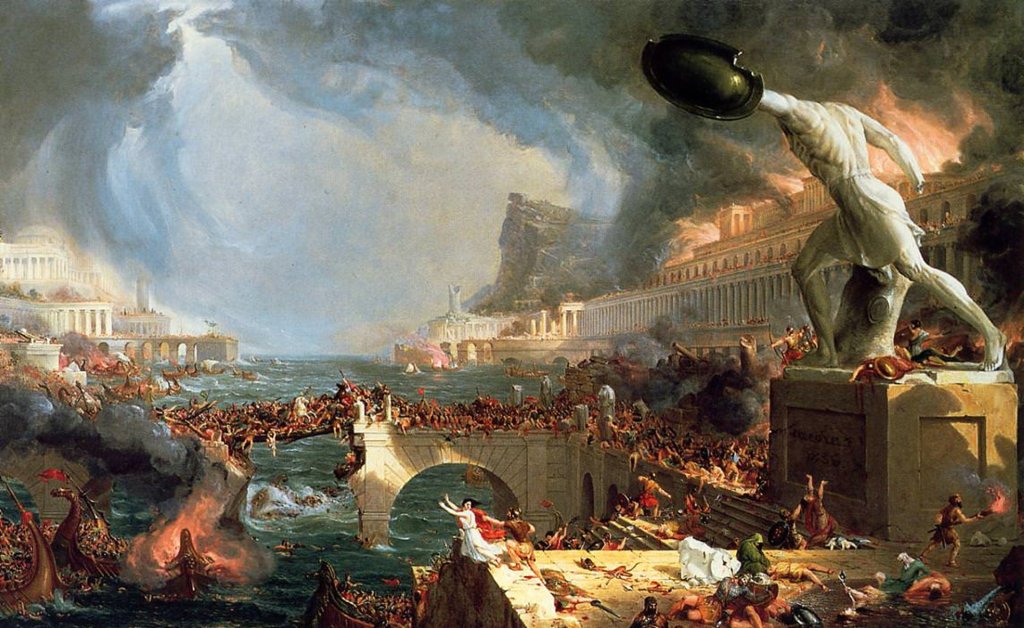
This painting is a representation of Rome’s government’s corruption.
Since the fall of Ancient Rome, much has changed in the world, but there are also some similarities with the past. Some of the ways in which things have changed and stayed the same are as followed.
Change:
Advancements in Technology: The world has seen tremendous advancements in technology since the fall of Ancient Rome. From the invention of the printing press to the development of the internet, these advancements have changed the way people communicate and interact with each other.
Globalization: The world has become much more interconnected since the fall of Ancient Rome. The growth of trade, travel, and communication has brought people from different parts of the world closer together and created a global community.
Democratic Systems of Government: Since the fall of Ancient Rome, there has been a trend towards democratic forms of government. While the Roman Empire was ruled by an autocrat, today, many countries have adopted democratic systems that provide citizens with a voice in how they are governed.
Staying the Same:
The Importance of Power: Despite the many changes that have taken place since the fall of Ancient Rome, the importance of power has remained constant. Whether it is the power of an individual, a group, or a nation, the desire for power and control has remained a driving force in human history.
The Cycle of Rise and Fall: Throughout history, civilizations have risen and fallen. While the specifics may vary, the cycle of rise and fall has remained constant. The fall of Ancient Rome serves as a reminder of this cycle and the need for caution and humility in the pursuit of power.
Human Nature: Despite the many advancements and changes that have taken place since the fall of Ancient Rome, human nature has remained relatively unchanged. People are still driven by their desires, fears, and ambitions, just as they were in Ancient Rome.
In conclusion, since the fall of Ancient Rome, much has changed in the world, but there are also some similarities with the past. The advancements in technology, the growth of globalization, and the trend toward democratic systems of government are just a few of the ways in which the world has changed. However, the importance of power, the cycle of rise and fall, and human nature are among the ways in which things have remained the same.
It is difficult to say definitively whether the changes since the fall of Ancient Rome are positive or negative as it depends on one’s perspective. Some people may view certain changes as positive, while others may see them as negative, here are a few examples.
Positive Changes:
Advancements in Medicine: The advancements in medicine since the fall of Ancient Rome have greatly improved the health and longevity of people around the world.
Increased Access to Information: The growth of communication and technology has made it easier for people to access information and knowledge from all over the world.
Increased Political Freedom: The trend towards democratic forms of government has given people more control over their own lives and increased political freedom.
Negative Changes:
Environmental Degradation: The growth of industry and technology has led to environmental degradation and the depletion of natural resources.
Increased Income Inequality: Despite the many advancements in technology and the growth of the global economy, income inequality has also increased, leading to a widening gap between the rich and the poor.
Global Conflicts: The increased interconnectedness of the world has led to greater opportunities for conflict, both between and within countries.
In conclusion, the changes since the fall of Ancient Rome can be viewed as both positive and negative, depending on one’s perspective. While advancements in medicine and increased access to information are among the positive changes, environmental degradation and increased income inequality are among the negative changes. Ultimately, the impact of these changes depends on how they are managed and addressed by society.
The fall of ancient Rome was a complex and gradual process that took place over several centuries. It is difficult to pinpoint a specific date or event that marked the fall of the Roman Empire.
However, there were several factors that contributed to the decline and eventual fall of ancient Rome. These factors include political instability, economic troubles, military overstretch, and the invasion of barbarian tribes.
Political instability was a major factor in the fall of Rome. Starting in the 3rd century CE, the Roman Empire went through a period of political instability and frequent changes in leadership. This period of turmoil was characterized by frequent civil wars, the rise of military strongmen, and the decline of traditional Roman political institutions.
Economic troubles were also a major factor in the decline of the Roman Empire. The economy was heavily dependent on slave labour, which became increasingly scarce as the empire expanded and conquered new territories. This led to rising labour costs and a decline in agricultural productivity.
Military overstretch was another factor in the decline of Rome. The empire was constantly expanding and engaging in wars on multiple fronts, which placed a strain on its military and resources.
Finally, the invasion of barbarian tribes in the 4th and 5th centuries CE was a major contributing factor to the fall of Rome. These tribes, including the Visigoths and the Huns, were able to penetrate the empire’s borders and weaken its military and infrastructure.
Overall, the changes that led to the fall of ancient Rome were gradual and occurred over a long period of time, rather than happening rapidly.
The fall of ancient Rome is generally considered to be a major turning point in Western history. The Roman Empire had a profound influence on the development of Western civilization, and its collapse marked the end of a period of stability and order that lasted for centuries.
The fall of Rome had far-reaching consequences, both in the short term and in the long term. In the short term, the collapse of the Roman Empire led to a period of political instability and economic turmoil in Europe. The power vacuum left by Rome’s collapse allowed for the rise of new political entities and the formation of new political and economic systems.
In the long term, the fall of Rome had a profound impact on the development of Western civilization. Many of the institutions and cultural values that are still prevalent in the West today can be traced back to the legacy of ancient Rome. The Roman Empire contributed to the development of the concept of citizenship, the rule of law, and the creation of a common language and culture in Europe.
After the fall of Rome, Europe went through a period of cultural and intellectual decline known as the Dark Ages. However, the legacy of Rome lived on in the form of the Catholic Church, which preserved much of the knowledge and learning of the ancient world.
In summary, the fall of ancient Rome marked a major turning point in Western history and had far-reaching consequences that are still felt today.
 Ancient Rome